Who Killed Homer?
“Not everything that counts can be counted, and not everything that can be counted counts.”— William Bruce Cameron
Eros Against the Machine
On Death, Desire, and the Lost Fire of Belonging
There was once a fire at the centre of the world, if you’ll allow me to begin where all the good stories do — in the dark, with something burning.
People gathered round it not merely for warmth, but for protection, for memory, for meaning. They turned their faces to one another as the stories came: gods and wanderers, warriors and the long, impossible business of coming home. The flame drew them into a circle. Beyond it waited the darkness; within it, a community remembered who it was. The fire, you see, did not merely keep them warm. It kept them theirs.
The Most Elegant Loneliness Ever Devised
Today the fire has been swapped, rather quietly, for the screen.
The shape is nearly identical — millions of faces turned towards a glowing centre, as though nothing had changed at all. And yet each of us sits alone before a private stream, arranged by an invisible hand with impeccable, unsettling care. We appear connected; we rarely inhabit the same world. The ancient fire conjured a shared reality. The modern screen offers each of us a personalised solitude, gift-wrapped and lit from within.
It may well be the most elegant loneliness ever devised. One almost wants to applaud.
From the Circle to the Pyramid
The old Greek imagination understood life horizontally. Human beings lived among other human beings, beneath one sky, inside the same mortal predicament. Wisdom was never an escape from the world but the rather harder art of inhabiting it well.
Time, too, moved in circles — spring, summer, autumn, winter; birth, flowering, decline, return. The world had its limits, and the reverence for those limits was called measure. To trample them was not progress. It was hubris, and the Greeks knew precisely how that story ended.
Our age, by contrast, prefers a vertical architecture.
Power descends from above. Institutions, governments, corporations and platforms arrange the lives beneath them like beads on a string. Human worth is translated, helpfully, into figures — productivity, credit, performance, followers, risk, engagement, profit. Even the old language of the soul has been gently retired and replaced with the language of management.
We no longer ask whether a thing is good. We ask whether it performs.
And so the citizen becomes a consumer, the patient a cost, the worker a resource, and the human being a tidy little constellation of data points. Life itself is treated as an enterprise — to be improved, measured, and optimised without end. One is expected to grow richer, fitter, younger, more visible, more efficient and — rather inconveniently — immortal. The system is forever promising paradise, though it has lately given paradise a subscription fee.
III. The Oldest Fear in the World
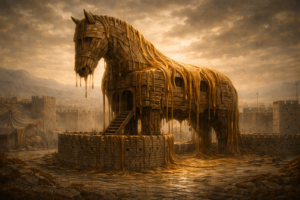
Beneath all this clever machinery lies something extraordinarily ancient: our fear of death.
Every living creature carries the command to survive — written deep into the marrow, to eat, defend, retreat, reproduce, endure. Human institutions have always understood the exquisite leverage of this instinct. Some promise salvation after death; others, security before it. The market offers youth and status and distraction; technology whispers of preserved minds and digital selves and a synthetic forever. Each presents itself, modestly, as the keeper of the keys.
Give us your obedience, your labour, your money, your attention, your data — and perhaps the great darkness may be postponed. The promise keeps changing costume. The bargain stays remarkably the same.
And yet — here is the inconvenient truth — a soul that has made its peace with mortality becomes terribly difficult to govern through fear. When death is received as part of nature rather than treated as a personal administrative failure, something within the human being quietly stands upright.
This is why the tragic imagination matters so. Achilles knows he will die. Leonidas knows. Antigone knows. Not one of them is offered an insurance policy against the dark. Their dignity comes from how they stand before the inevitable — before the friend, the enemy, the city, and the final border of a life. Their immortality requires no intermediary at all. It lives in action, in love, in the long memory of those who remain.
The Death of Homer
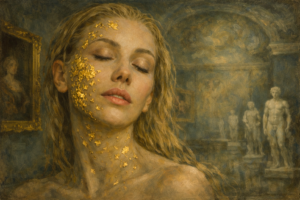
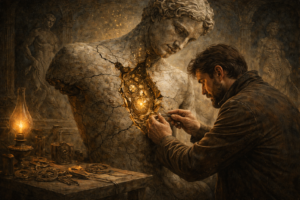
Homer was never merely a poet. He was a vessel of collective memory.
His epics taught a people how courage might sit beside grief, how glory could be shadowed by loss, how even the mightiest warrior might weep for someone he loved. The poems preserved not information but a pattern of being human — which is a far rarer and more perishable thing.
So when classical learning slips away, something larger than a syllabus is lost. We lose a language for honour, restraint, mortality, friendship and responsibility. The humanities once set the ethical question beside the technical one: they asked the physician not merely whether a thing could be done, but whether it ought; asked the economist what prosperity was for, the architect whom the city served, the scientist what should remain untouched even when it could be seized. Without that moral imagination, the expert may know everything about the fragment and almost nothing of the whole.
The vanishing of Homer is not the quiet retirement of an old book from a reading list. It is the breaking of a common mirror. And in its place another mirror appears — the screen — in which each of us beholds a private reflection, selected, adjusted, and monetised by someone we shall never meet.
Where Homer offered memory, the feed offers novelty. Where wisdom asked for patience, information arrives without mercy or end. Where glory once meant being remembered by one’s people, visibility is now tallied in views. We have traded remembrance for metrics, and are faintly astonished to find ourselves forgotten.
Eros and the Beautiful Insurrection
There are, mercifully, two forces capable of interrupting the instinct of self-preservation.
One is revolution. The other is Eros.
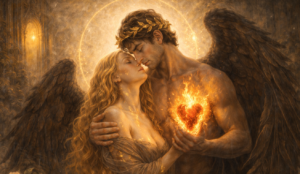
Not revolution as mere violence or political theatre, but as that vertiginous moment when a human being sets dignity, or freedom, or solidarity above personal safety. And not Eros as mere appetite, but as the mysterious event by which another life becomes as precious as one’s own. The lover and the rebel share a single dangerous secret: each has found something more valuable than survival.
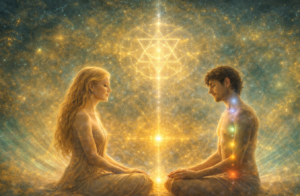
Eros draws us out of the sealed chamber of the self. It thins the walls of our isolation; it makes another person unbearably, gloriously real. For one astonishing moment, one is no longer a solitary organism haggling for advantage. One belongs.
This is why love has always carried a faintly revolutionary perfume. A creature who truly loves cannot be wholly reduced to a consumer. Desire — when it is alive and embodied — refuses the cold substitutions of the marketplace. It cannot be fully appeased by images, purchased experiences, or frictionless little simulations. It wants presence: the risk of being seen, touched, undone, changed.
Sex, affection and love may keep separate houses, but they live on the same street — and all of it leads away from isolation, towards encounter.
Eros is the belonging of two. Revolution, at its most humane, is the belonging of many. Both say the same forbidden sentence: your life is bound to mine.
The Economy of Endless Hunger
The modern economic order offers a union of its own: universal indebtedness.
Debt multiplies mathematically, while the world stubbornly remains finite. Money may breed as an abstraction, but soil tires, machines decay, bodies age, and the well runs dry. An economy that demands infinite expansion within a limited world will, in time, begin to devour its own foundations.
When there are no new territories left to swallow, the machine turns inward. It feeds on homes, pensions, savings, health, attention, time. Even the self becomes raw material. Our preferences are tracked, our longing forecast, our loneliness alchemised into engagement. We pay the new landlords not only in coin but in hours of consciousness. The rent, these days, is extracted in attention.
This is the quiet genius of technofeudalism: it grants us the sensation of participation while quietly concentrating ownership elsewhere. We speak, post, desire and perform upon territories that were never, for one moment, ours. The medieval serf worked land owned by the lord. The modern serf cultivates a profile on a platform — and calls it freedom.
Returning to the Fire
The answer is not to romanticise antiquity, nor to flee every machine in a fit of pique. Nor — let us be honest — to imagine that suffering politely dissolves the moment one reads Homer by candlelight. (A charming prospect, that, though absolute murder on the eyesight.)
The answer is to restore the human centre.
We must make spaces where people meet one another without becoming products; where knowledge is wedded to conscience; where mortality is neither denied nor exploited; where pleasure is not mistaken for consumption; and where worth cannot be wholly written as a price. We must recover the slow intelligence of the body, the lost discipline of attention, the plain courage to stay present with another soul.
And above all, we must reclaim our quarrel with death — not through morbidity, but through intimacy with life. To remember that time is finite is to rescue it from those who would so happily spend it on our behalf.
Death gives shape to love. Limits give shape to beauty. And perhaps the true revolution begins the moment we stop asking how to live forever, and start asking what is worthy of the life already burning within us.
The fire has not gone out. It survives wherever people gather without calculation; wherever tenderness and defiance share a single body; wherever someone chooses presence over performance, and relationship over fear.
It survives in the lover who dares to be known. In the friend who remains. In the community that still remembers. And in every soul who looks upon the vast machinery of isolation and — with a certain ancient insolence — chooses, anyway, to belong.
♥ — Ophelia