

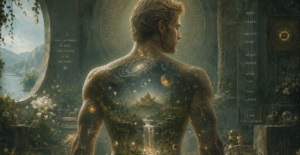
A Gift Called Madness
”The greatest of blessings come to us through madness, when it is given as a gift from the gods.”
Plato, Phaedrus 244a
Sometimes, in our work, something happens that frightens you a little. A breath goes deeper than you meant it to, a tremor runs through the body, tears arrive from nowhere, or a wave of feeling lifts you out of yourself. Afterwards you laugh and say that you thought you were losing your mind.
I want to tell you about a Greek idea that may change how you hear those words. For Plato, not all madness is a loss. Some of it is a gift.
A Word We Have Learned to Fear
Today, when we hear the word madness, we think of something gone wrong. But place the word sacred in front of it, and everything changes. In the Phaedrus, Plato presents sacred madness as a blessing from the gods: a key that opens doors, unlocks what is closed in us, and makes us more than we were.
The dialogue is about eros. Before Socrates speaks, others describe love as a kind of madness, and the lover as someone who has lost their reason. We all know a little of what they mean.
At first Socrates seems to agree. Then he does something remarkable: he takes it back. In a palinode, a formal recantation, he declares eros a sacred gift, one of four divine madnesses, and gives it to Aphrodite and her son Eros.
Four Doors
There are four sacred madnesses, and each has its god. The Lover belongs to Aphrodite and Eros, and the Seer, who speaks prophecy, to Apollo. The Initiate, carried by ceremony and the mysteries, belongs to Dionysus; this is the telestic madness, from the Greek word for rites. The Poet belongs to the nine Muses, whose leader is Apollo himself, Apollo Mousagétes.
What unites them is ecstasy. In each, I step beyond my ego, my roles and my everyday idea of myself. As a soul, I come into direct contact with the divine.
The Greeks had a word for what is received there: epipnoia, inspiration, literally a breathing-upon. Something divine breathes into me and lifts me to a higher level of being. You will understand why I love this word, because in our work everything begins with breath.
The Greatest of Blessings
Plato does not say that madness brings us some benefits. He says it brings us the greatest of blessings.
In his Laws, he separates human goods, such as health and beauty, from divine goods, such as wisdom, justice and self-command. And yet here, above all of them, he places what comes to us through madness.
It comes, he insists, as a gift. It is not earned or engineered. It descends from a higher level, like rain on a field, and our part is to be ready to receive it.
The Oak at Dodona
Socrates offers examples. The prophetess at Delphi and the priestesses at Dodona, he says, did great good for individuals and for all of Greece when seized by sacred madness. When they were merely sensible, they did little or nothing.
Dodona was among the oldest oracles of all, where Zeus was worshipped beside Dione, a masculine and a feminine principle side by side. Its priests, the Selloi, went with unwashed feet and slept on the bare earth. They heard the god in the rustling of the sacred oak.
If he listed the Sibyl and all the others who foretold the future in a state of inspiration, Socrates adds, helping so many, he would never finish. The point, he says, is plain to everyone.
A Letter Added by Those Who Lost Their Taste
Then Plato plays with words, as he likes to do. His dialogues are not dictionaries; an etymology, for him, is a way of making a philosophical point.
The ancients who named things, he says, did not think madness shameful. They called the noblest art, the reading of the future, manikē, the mad art, because they knew that madness sent by the gods is a beautiful thing. Later generations, lacking that sense of beauty, slipped in a letter and called it mantikē, divination.
The Greek for such people is apeirokaloi, those without taste, the opposite of the philokalos, the lover of beauty, harmony and right proportion. Keep that ideal of measure close, because Plato is careful here. He is not praising every loss of control, nor the madness of illness, which he treats as something else entirely; he means madness given by the gods.
Birds, Opinions and the Limits of Cleverness
Plato then sets inspired prophecy beside augury, the art of reading birds. A man in full possession of his reason watches a bird fly calmly from left to right and concludes that good fortune is coming. It is careful work, and entirely human: an opinion filtered through one mind, assembled like the findings of a historia, an inquiry.
Plato calls the inspired kind more complete and more worthy of honour. Collecting information, however carefully, is not the same as being opened from within.
This is not the only place where Plato leads us past ordinary reason. In the Meno, the Theaetetus and the image of the divided line, he shows that mathematics, music, astronomy, the arts and the sciences carry us a long way, but not all the way. At the top of the line is not calculation but direct seeing, and Dionysus, god of wine and release, stands for that last opening.
That final step is the Delphic one: γνῶθι σεαυτόν, know thyself. You are a wonder, and you were not made only to wake, work, eat, shop, sleep and repeat. But to discover it, something must open beyond habitual control and judgement.
So between our sessions, I invite you to three small disciplines. Notice a judgement as it rises, and set it down unspoken. Keep a notebook by your bed and write your dreams before they fade, and now and then let your hand write without deciding what comes next.
What the Ancestors Leave Us
The next gift belongs to the Initiate. Certain families, Plato says, were afflicted by sickness and terrible hardship, rooted in ancient wrongs that had stirred divine wrath. His word for that wrath shares its root with the wrath of Achilles that opens the Iliad.
A family, a genos, carries what earlier generations could not resolve: their mistakes, their wrongdoing, their unfinished grief. Sacred madness showed those families the way out. It led them to prayer, worship, purification and rites, and so prophecy and initiation met.
Through those rites, Plato says, the sufferer was released, for the present and for the time to come. Something that had held them captive was loosened. I think of this often when a body begins, very slowly, to let go of what it has carried for longer than it can remember.
The Untrodden Soul
The third gift belongs to the Poet. The madness of the Muses, Plato says, takes hold of a soul that is tender and abatos, untrodden, like ground no foot has touched. It wakes that soul, lifts it into Bacchic ecstasy beyond the ego, and pours out song and every kind of poetry.
That poetry has a purpose. By celebrating the deeds of those who came before, it teaches those who come after, and memory becomes a gift passed down.
But whoever approaches the doors of the Muses without their madness, trusting technique alone, remains atelēs: unfinished, short of the telos that is the true aim. The poetry of the merely sober is eclipsed by the poetry of the inspired. Work born in that state carries a different power, which is why I asked you to let your hand write freely.
The Clever and the Wise
Socrates draws his conclusion. We should not be afraid of this madness, nor let anyone persuade us that the sober, sensible person is always to be preferred to one who has been moved by a god.
So he returns to the Lover, and to the old argument that we should choose a calm non-lover over someone in love. If love is sent by the gods for the good of both lover and beloved, then it is no affliction but a gift, given, he says, for our greatest good fortune, eutychia. His proof, he warns, will not convince the merely clever, but the wise will recognise it.
Cleverness can analyse a feeling until it closes. Wisdom senses that something higher is at work.
To understand any of this, Socrates says, we must first know the nature of the soul, human and divine: how it is moved, and how it acts. That is where Plato goes next, and it is where our work goes too.
The space we share is not there to make you lose your mind. It is there to hold you, with breath, with consent and with measure, while something larger than your everyday self breathes in.
Which door is already opening in you? And what might you receive, if you stopped mistaking the gift for a loss?
♥ — Ophelia