

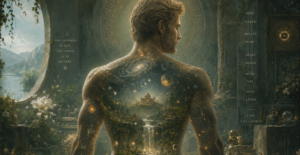
Teresa of Ávila, the Shadow and the Alchemy of the Soul
According to Teresa of Ávila, a castle lies hidden within every human being.
It has no earthly address, yet we spend much of our lives circling its gates. Within it are chambers of increasing depth—rooms in which illusion falls away and the familiar self is gradually brought into contact with something greater.
Teresa called it the Interior Castle.
Today, we might call it the psyche, the soul or the deeper Self. The language changes across centuries, yet the journey remains recognisable.
Teresa wrote five hundred years ago of people too busy to remember their souls, their minds occupied by a thousand lesser matters. Apparently, humanity required no smartphones to become distracted from itself.
Her question still stands:
Where is your heart truly living?
Not where you say it lives, but where your attention, fear and desire continually return.
The Intensity of the Mystical Life
Teresa spoke to God with astonishing intimacy. Her language belonged to another age, yet beneath its theology was something universal: intensity.
The mystic does not merely study truth.
She desires to be transformed by it.
She says:
Show me what I conceal.
Burn away what is false.
Lead me beyond the identity I already know.
Whether we call the destination God, consciousness, the soul or the Self matters less than the sincerity of the approach.
Mysticism is not principally a system of belief.
It is the willingness to be changed.
The Three Movements of Transformation
The mystical journey follows three essential movements:
Purification.
Illumination.
Union.
These stages appear not only in religion, but throughout life.
A relationship must move through confusion and dishonesty before truth becomes visible. A creative work must lose what is unnecessary before its form emerges. The psyche must encounter its shadow before greater wholeness becomes possible.
Most people undergo this journey indirectly, through loss, conflict and repetition.
The mystic enters it consciously.
Rather than waiting for life to force transformation through the back door, the seeker calls it by name and walks towards it.
Purification and the Shadow
Purification does not mean becoming morally perfect. It means becoming honest.
We may say that we are not angry while resentment fills the room. We may call ourselves generous while secretly keeping an account of what others owe us. We may call something love when it is partly control, dependency or fear.
Purification begins when the contradiction can no longer be hidden.
In Jungian language, this is the encounter with the shadow—the motives, impulses and qualities the conscious personality refuses to recognise as its own.
The ego says:
I only want justice.
The shadow asks:
Or do you enjoy the superiority your injury gives you?
The ego says:
I would never hurt another person.
The shadow asks:
What happens when you feel humiliated?
Purification is not self-loathing.
It is the end of self-flattery.
Nothing can become whole while part of it remains unnamed.
The Reptiles in the Castle
Teresa described the early chambers as troubled by creatures from the outer world.
Psychologically, these creatures resemble fear, grievance, vanity and the hunger for control. Once they enter the castle, they distort perception.
Fear of humiliation is particularly powerful. Under its influence, disagreement feels like attack and criticism feels like annihilation.
The fragile ego demands:
You must respect me.
You must recognise my value.
You must behave according to my expectations.
Yet the deeper question is not whether other people have behaved well. Often, they have not.
The question is why their behaviour holds such power over our interior life.
What wound are we defending?
What identity feels threatened?
What recognition have we made essential to our worth?
Until these questions are faced, we imagine that peace will arrive only when the outer world becomes obedient.
The castle teaches otherwise.
The first work is within.
The Illusion of Entitlement
Much suffering grows from the hidden belief that life should follow our private sense of justice.
We believe effort should guarantee success, loyalty should prevent betrayal, goodness should protect us from pain and love should make abandonment impossible.
These desires are human, but they can become contracts reality never signed.
We suffer not only because something painful happened, but because we believe it should never have happened to us.
Teresa’s path does not ask us to excuse cruelty or abandon boundaries. It asks us to examine the belief that the universe is personally obliged to honour our preferred story.
We may seek justice without expecting immunity from suffering.
We may grieve without building our identity around what life owes us.
We may release resentment without pretending the wound was insignificant.
The surrender of entitlement is not defeat.
It is freedom from an impossible contract.
The Seed of War
The castle reveals that the violence we condemn in the world begins, in smaller form, within the human psyche.
When someone injures us, we may rehearse the grievance, gather supporters and quietly enjoy the moral authority it provides.
The wound becomes a throne.
From it, we divide people into the innocent and the guilty, the loyal and the treacherous.
This same psychological seed, magnified collectively, contributes to war. Violence requires certainty, dehumanisation and a story in which one side possesses complete virtue while the other carries complete guilt.
Recognising this possibility within ourselves should not produce shame.
It should produce compassion.
We begin to understand how frightened, wounded people become destructive—not because evil belongs to some alien species, but because its ingredients exist within the ordinary psyche.
What remains unconscious governs us while pretending to be righteousness.
Illumination
After purification comes illumination.
Illumination is the moment when something becomes unmistakably clear.
We recognise why a pattern keeps returning. We see that a conflict blamed entirely on another person also serves something within us. We understand that the role we have mastered may be the very thing preventing our growth.
True illumination is more than intellectual understanding.
A truth may be logically known for years without changing us. Illumination occurs when it enters the body and reorganises perception.
The old story loses its authority.
This is why Teresa said that we cannot reason our way entirely into the castle. Reason is useful, but the deeper chambers require contemplation, humility and receptivity.
The ego prefers conclusions it can control.
The soul waits to be shown.
Prayer and Surrender
For Teresa, prayer was the way inward.
Prayer need not be understood merely as asking for divine intervention. At its deepest, it is the surrender of the managerial mind.
It says:
I may not see clearly.
My preferred explanation may be incomplete.
I am willing to receive a truth I did not construct.
This is humbling, which is precisely why prayer can feel uncomfortable.
The ego would rather improve itself than yield itself. It prefers a spiritual programme with predictable rewards.
But the castle cannot be conquered. Mystical experience cannot be scheduled. It arrives, if it arrives, without regard for the ego’s timetable.
The inner door opens through consent, not force.
The Dark Night
No serious journey inward avoids darkness.
John of the Cross called it the Dark Night of the Soul—the period when familiar sources of identity, meaning and consolation fall away.
The old explanations no longer work. The future cannot be imagined. Reason reaches its limit.
The Dark Night should not be confused with clinical depression, nor should psychological suffering be spiritualised or left untreated. It is a mystical symbol for the dismantling of an identity that can no longer carry the soul forward.
The ego asks how it can return to its former life.
But transformation may require that the former self not return.
The Dark Night is not always a tunnel leading back to who we were.
Sometimes it is the passage through which that person is released.
Healing as Transformation
Healing does not necessarily mean returning to the state that existed before pain.
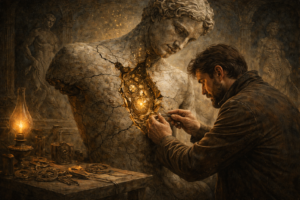
Sometimes we cannot become who we were before the wound. We must become someone whom the wound helped reveal but no longer controls.
Spiritual practice may offer meaning, resilience and inner transformation, but it should never replace appropriate medical or psychological care. Illness is not proof of spiritual failure.
The deeper insight is that genuine healing changes our relationship to life.
Pain is not declared good.
Loss is not romanticised.
Yet suffering is not granted the final word.
The wounded identity loosens, and a larger life begins to emerge.
Union and the Deeper Self
The final movement is union.
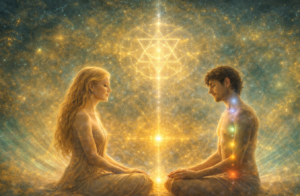
The mystic speaks of union with God. Jung might describe it as a relationship between the ego and the Self—the greater totality of the psyche.
Union does not mean that personality disappears or that conflict ends forever.
It means the ego no longer believes itself to be the whole being.
One begins to live from a deeper centre.
This transforms our understanding of power.
Ordinary power tries to control people, outcomes and perceptions. But we cannot force another person to love us, make the unhappy happy or guarantee ourselves another day.
Much of what we call power is merely the ability to disturb others.
The soul seeks another kind: the power to remain inwardly coherent, to tell the truth without cruelty, to release resentment and to act without controlling the result.
It may appear modest.
Yet it is the beginning of freedom.
Crossing the Drawbridge
Imagine standing before the castle.
Behind you lies the familiar world of noise, blame and defence. Before you is the drawbridge.
You cross it and become still.
At first, you encounter not angels, but fear, entitlement, grievance and pride. The castle does not flatter.
It reveals.
If you remain, these creatures begin to lose their power. Behind them lies a quieter chamber.
Then another.
Purification.
Illumination.
Union.
The pattern repeats like a spiral turning towards the centre.
The soul cannot be transformed by a single revelation. We must meet ourselves repeatedly, under different light and at different stages of life.
At the centre of the castle, we discover that we were never the rulers of existence.
Strangely, this does not diminish us.
It relieves us.
We no longer need to control the stars, command every outcome or persuade the world to confirm our importance.
We are asked only to become honest, present and available to the life we have been given.
The castle waits beneath the noise of the present moment.
Its door opens whenever we choose truth over performance, humility over entitlement and transformation over the safety of remaining unchanged.
The life we are so busily defending is already passing.
The soul is asking to be entered.
♥ — Ophelia