
The Weight of What We Carry: On Spiritual Crisis, Psychic Weight, and the Speed of Healing
“Faith is a dark night for the soul, but it is in this very darkness that light is given.” — St John of the Cross
There is a peculiar fluency in our age. Ask a person what they believe, and they will falter. Ask them what they do not believe, and they will speak with the eloquence of a barrister. We have become connoisseurs of doubt — articulate about every god we have dismissed, silent about whatever it is we are still, secretly, searching for.
And searching we are. The seeking never seems to end, and the arriving never seems to come. We circle the temple without ever entering it. This is not, I want to suggest, a small cultural quirk. It is the defining wound of our time — and it wears a disguise.
The Crisis That Wears the Wrong Name
We are living through what is routinely called an epidemic of depression. But sit with enough people in the quiet hours — as I do, in the sanctuary of this work — and a pattern begins to reveal itself. Beneath the flatness, beneath the exhaustion, one hears the same refrain again and again: there must be a purpose to my life. There must be something more than this.
That is not the language of a purely psychological wound. That is the language of a spiritual crisis — and most of us can no longer tell the difference, because we have quietly deleted the vocabulary that would allow us to name it.
We have extracted holy language from our speech. Words like sacred, soul, grace, calling now embarrass us; we reach for them and pull back, as one pulls back from a too-intimate touch at a dinner party. But a civilisation that loses its sacred vocabulary does not lose the sacred — it merely loses the ability to navigate it. The compass remains; we have simply thrown away the words written on its face.
What the mystics called the dark night of the soul — that terrain John of the Cross mapped with such terrible precision — has not vanished from human experience. It has simply been rebranded as a chemical imbalance and sent home with a prescription. The night remains. We have only forgotten it is a passage, and not a permanent address.
The Economics of the Soul
Here is an image worth keeping: imagine you are issued, each morning, one hundred pounds of vital energy. Not sterling — something far less negotiable. This is your allowance for the day: the currency with which you must run your body, your thoughts, your immune system, your relationships, your desire.
Now ask yourself: where is it actually being spent?
Every unresolved wound, every ancient grievance, every memory you circle like a widow at a grave — each of these is an anchor, and every anchor draws a standing charge against your daily allowance. Five pounds to that betrayal from a decade ago. Ten to the parent who never saw you. Twelve to the version of your life that never arrived.
This is investment in the dead. And the arithmetic is unforgiving: whatever you spend minding the past is unavailable for animating the present. This, I suspect, is why so many of us find that the healing arts — the acupuncture, the bodywork, the beautiful rituals of restoration — soothe but do not transform. They may quiet the pain for a day. But deep change is an energetic proposition before it is a physical one, and it requires a self with capital left to invest. A soul running on overdraft can receive touch, but cannot yet be moved by it.
Psychic Weight, and the Speed of Healing
There is another way to speak of these anchors: as psychic weight. And here the language turns wickedly precise — because the more weight you carry, the longer you wait. For healing. For love. For the life you keep insisting you want.
Consider the geometry of consciousness. There is the horizontal axis: linear time, sequence, the slow grind of one thing after another. And there is the vertical: the lightning strike of direct knowing, the aha that runs through the whole body like a struck bell, thought becoming form in a single breath. Every one of us has tasted this — the moment of insight that arrives complete, needing no argument.
The vertical is always available. So why do we live so stubbornly on the horizontal?
Because — and this is the uncomfortable jewel at the centre of it — we are regulating the speed at which we are willing to know. Truth at full velocity would demand action at full velocity. The woman who senses her marriage is over in three seconds would have to live as though it were over by five o’clock. And so, quite unconsciously, she reaches for the lever and slows the machinery down: five years of denial, please, and the gradual exile of every friend who refuses to play along. Then, when the truth finally surfaces, the inevitable confession: I knew it years ago. I simply didn’t want it that fast.
We do the same with healing. The inability to forgive is not a character flaw; it is a braking system. We are holding on — and the holding has a cost we rarely calculate until the body presents the invoice.
The Transparent Self
Here is a truth both humbling and strangely liberating: you are not hidden. You never were.
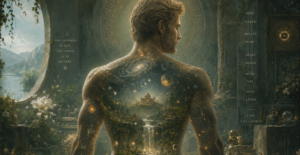
We are no longer merely five-sensory creatures, if we ever were. We are multi-sensory beings — perceiving through intuition, through the body, through the subtle registers of emotional and spiritual sense. And this perceptual apparatus runs constantly, in everyone. You scan every person who enters the room for their archetypes — their patterns of power — with the speed of instinct, and you are uncannily accurate. And they, beloved, are doing precisely the same to you.
Which dissolves a certain flattering illusion: that you are the sole observer in a world of the observed, the one consciousness at the window while everyone else is merely scenery. You are as legible to others as they are to you. The woman who spends years deliberating whether to leave her marriage, never once imagining her husband might be conducting the same private inquiry about her — she is not deceived by him. She is deceived by the fantasy of her own opacity.
To accept one’s transparency is a spiritual discipline. It is the end of the sovereign, sealed self — and the beginning of something far more interesting.
One Body, Breathing
Which brings us to the largest truth, the one that asks the most of us: we do not create our reality alone.
That phrase — you create your own reality — has been reduced in the modern spiritual marketplace to a kind of cosmic shopping list: want it, visualise it, click your heels. But the original mystical insight is of an altogether higher voltage. We co-create — with each other, with every living system we touch — which means my inner life is not privately mine, and neither is yours. The boundary where “my reality” ends and “yours” begins cannot actually be located. What is in the one is in the whole.
Read symbolically, our collective afflictions become legible as a kind of shared dreaming — the shadow of an entire people seeking a form. It is a sobering thought: that the fear, the isolation, the I must look after myself first — these are not private moods but contributions to a common atmosphere. One cell in a body, crying out that it is all alone, while the body breathes around it.
The irony of our moment is exquisite and painful. Just as we are learning that holism is the law of body, mind, and spirit — just as the old walls between self and world grow thin — we have chosen, en masse, to retreat. To withdraw from community, from communion, from the collective body itself. We have answered the discovery of our interconnection with an unprecedented experiment in isolation.
The way through — through this crisis and whatever crises are still gathering on the horizon — is not more armour. It is the recovery of the oldest knowledge we possess: that we are one living body, and that every choice made in fear wounds the very organism it claims to protect.
The Choice at the Turning Point
There arrives, in every genuine spiritual life, a threshold moment. You wake one morning and understand that you can no longer pretend not to hear yourself. The inner voice — that quiet, relentless intelligence you have been overriding for years — has become impossible to unhear.
And at that threshold, the choice is stark: ascend, or fall ill. Let the soul take the helm, or keep paying the anchors their daily tithe and call the exhaustion life.
This is what spiritual direction has always been for: not the acquisition of beliefs, but companionship at precisely this threshold. Someone to sit with you in the dark night and remind you that it is a night — which means, by its very nature, that there is a dawn on the other side of it.
From Soma to Psyche: Tantra Opens, Greece Sustains
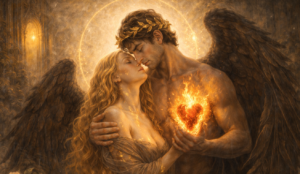
Begin with the body — the sacred always does. Tantra, is the sacred in her physical dress: breath as invocation, touch as scripture. She knows that psychic weight is never merely psychic — the unforgiven thing lives not in your opinions but in the breath held since goodness knows when, the pelvis that learned to brace before it learned to trust. One cannot think one’s way out of what the body is still faithfully performing. Tantric intimacy coaxes the anchor up as sensation rather than story, and there forgiveness ceases to be a virtue and becomes something the body simply does — a softening, the standing charge returned with interest.
But the body’s revelations are wild things, and wild things want a keeper. Enter the Greeks with aisthesis — perception itself as wisdom — lending the opened body a mind worthy of her: the strength to remain with what rises, unarmoured. Tantra flings the door open; Greece teaches you to stand in the doorway. Between them, psyche embodied: the soul no longer paying polite visits to her own house, but moving in, and staying.
♥ — Ophelia