



The Tree of Life and the Fungus
“Your task is not to seek for love, but merely to seek and find all the barriers within yourself that you have built against it”— Rumi
A human life, if you’ll permit the conceit, is rather like a tree. The roots are memory, lineage, the soil one happens to be born into; the trunk is this stubborn animal body; and the branches — ah, the branches — are love and imagination and the people we belong to. And here is the thing nobody tells you at dinner parties: a tree does not flourish on inner pluck alone. It depends, rather inconveniently, on the ground it has been planted in.
The Quiet Rot That Wears the Mask of Reason
Our age has cultivated a fungus about those roots. It is a quiet, well-mannered sort of rot, and it begins with a single tidy lie: that a soul can be weighed and ranked — by cleverness, by usefulness, by status, by the tireless little ledger of one’s digital self. What once strutted about as eugenics and social engineering now returns in softer slippers, forever murmuring who is desirable, who is worth the bother, who deserves to be looked at. It does not announce itself as cruelty. It announces itself as common sense, which is far more difficult to refuse.
The Serpent in the Branches
Technology, money, the academy, the state and the war-machine have begun, lately, to braid themselves into one another like ivy that has rather forgotten it isn’t the wall. Systems dressed as progress watch us, anticipate our wanting, and curate what we are permitted to fear and adore. The spectacle turns living into theatre; precarity keeps us anxious and obedient; the algorithm slips selected morsels of information where knowledge used to sit. And slowly — this is the cunning part — the structure outside us learns to speak in the first person. It becomes a voice within.
The fungus thrives, you understand, by parting the tree from its forest. It sorts us into markets and tribes and warring little factions, thinning out our fellow-feeling until the neighbour becomes a stranger and mere survival edges out the gentler business of belonging to one another. Tired, isolated, and faintly ashamed, we begin at last to believe the wretched proposition — that a life is precious only when it is efficient, profitable, or neatly measurable.
The Sacred Ladder of Ascending Fire
And yet. The Greeks, bless them, knew that no creature so peculiar as a human being could ever bloom on usefulness alone.
Know thyself, said the stone at Delphi — and it was not, whatever the wellness industry insists, an invitation to assemble a more saleable persona. It was a summons to go down: beneath the surface, beneath the performance, into the hidden architecture of the soul. Socrates held that the unexamined life leaves one quite defenceless against illusion. Plato spoke of education as a turning of the whole soul away from shadows and towards the real. And Aristotle named the good life eudaimonia — not a heap of pleasures nor a fat purse, but the full flowering of a human creature through virtue, friendship, contemplation, and a meaningful hand in the life of one’s city.
Even eros, in Greek hands, reached past mere appetite. In the Symposium, love is a sacred ache that may well begin with a longing for one lovely body, but climbs — beauty to wisdom, wisdom to truth. The beloved is a rung, not a resting place. They wake in us something that wishes to grow beyond possession, beyond the small, fortified self.
The Temple Made of Flesh
Tantra, in another tongue and through the body, has been saying very much the same thing all along.
For tantra is not, whatever the brochures imply, an escape into pleasure, nor a clever catalogue of techniques. It is a discipline of presence — and rather a demanding one. It teaches that the body is not the obstacle to awakening but one of its doorways. Breath, sensation, the willingness to be undefended, touch offered with attention: these become the slow road home, back to the self that lives beneath the posturing and the armour.
The Spell That Stills the Machine
True intimacy, you see, jams the machinery. It asks us to stop measuring and producing and managing for one blessed moment. In a genuine encounter the other is no longer a function or a status or an image, but a living presence — astonishing, particular, unrepeatable. To be touched with awareness is to remember that the body was never a product. To be seen without judgement is to feel the imposed identity loosen its grip. To breathe alongside another is to recover a rhythm far older than the algorithm and considerably wiser.
This is why intimacy can become a path towards the higher self — not because some other person completes us (a romance plot, and a poor one), but because conscious connection shows us with great tenderness exactly where we have become divided within. It coaxes the exiled parts of the psyche into the light: fear, longing, shame, the secret wish to surrender control. Met with awareness rather than refusal, the life force — which had only ever gone quiet, never away — begins once more to move.
Greek philosophy calls us inward, to self-knowledge. Tantra calls us downward, into embodied presence. Both, in their different accents, insist that wisdom is never won by fleeing the human condition, but by entering it more deeply, and with rather more courage than is fashionable.
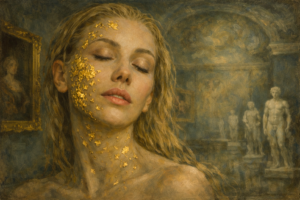
The Exiled Ones Return to the Light
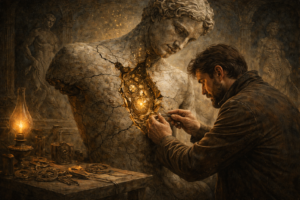
The tree does not heal by becoming less alive. It heals by returning to its roots — the body, the soul, friendship, truth, beauty, the long memory of a culture, the connections that actually mean something. The fungus may school us in competition and calculation and a low, ambient mistrust; but beneath the infected soil the roots are still, quietly, reaching for one another in the dark.
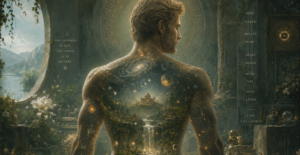
And our renewal begins the moment we remember that the highest self is not the most powerful, nor the most productive, nor the most exquisitely optimised version of us. It is the self most capable of presence, of discernment, of love and communion — the one self that no system, however clever, can ever wholly measure, predict, or possess.
♥ — Ophelia